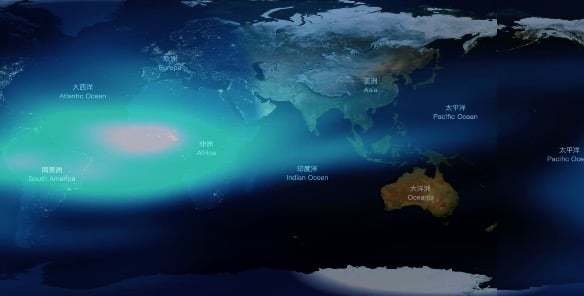
Intense solar activity has caused abnormal activity in the Earth's ionosphere, posing unprecedented challenges to global satellite positioning and navigation systems.
One of the core aspects of ionospheric research is the study of ionospheric delays. SpatiX has built and operates over 6,000 ground-based augmentation stations worldwide, forming a large-scale distribution. The massive volume of observational data collected over large areas and long periods has laid the foundation for research and precise analysis of ionospheric delays.
From automotive autonomous driving and mobile phone lane-level navigation to drone agricultural plant protection operations and power grid inspections... High-precision spatiotemporal services based on satellite navigation empower various industries. The consequences of satellite signal deviations caused by ionospheric activity cannot be ignored.
A chief scientist at SpatiX stated that there have been actual cases where drone flight deviations reached over 10 meters due to ionospheric effects. Autonomous driving requires positioning accuracy within 20 to 30 centimeters, but ionospheric activity has a significant impact on autonomous driving.
Solar activity is like the sun's occasional "mischievous" behavior, with the peak of the sunspot cycle expected around 2025. As smart devices increasingly rely on spatiotemporal services, their requirements for the accuracy, safety, and reliability of such services have also increased. It is anticipated that these impacts will persist for at least three years during the active phase of solar activity.
SpatiX has launched the first "atmospheric inference large model," which adopts the DiT architecture and combines multiple self-developed technological innovations to build an efficient atmospheric neural network base model. This enables more intelligent reduction of ionospheric errors and suppression of potential ionospheric impacts.
A SpatiX product manager explained that by obtaining the corresponding ionospheric error based on the position where the BeiDou satellite signal passes through the ionosphere, and transmitting this error to the user terminal, the terminal can then offset the ionospheric error, thereby achieving better positioning performance.