

Understanding GNSS RTK Technology: Basics and Importance
GNSS RTK (Global Navigation Satellite System Real-Time Kinematic) technology is a critical advancement in the field of high-precision positioning. Utilizing signals from multiple satellite constellations such as GPS, GLONASS, BeiDou, and Galileo, GNSS RTK enhances the accuracy of positioning data to the centimeter level. This is a significant improvement over standard GNSS, which typically offers accuracy within a few meters.
The importance of GNSS RTK technology cannot be overstated. It addresses common challenges faced by industries that require precise location data for their operations. From autonomous driving to precision agriculture, the ability to achieve such high accuracy in real-time enables safer, more efficient, and more reliable operations.
Key Mechanisms Behind GNSS RTK: How It Works
The core mechanism of GNSS RTK lies in the correction of the raw GNSS data using a network of ground-based reference stations. These stations provide real-time corrections to the GNSS signals, thereby significantly reducing errors caused by atmospheric conditions, satellite orbit deviations, and other factors.
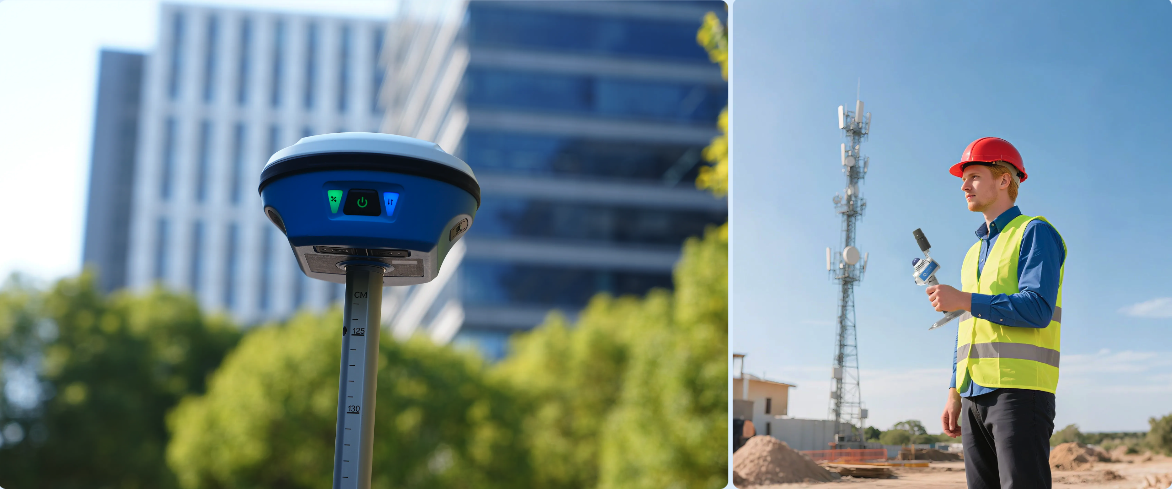
To achieve this, the GNSS RTK system involves two main components: a base station and a rover. The base station is fixed at a known location and continuously receives GNSS signals. It computes the errors in these signals and transmits the corrections to the rover. The rover, which is mobile, uses these corrections to adjust its own GNSS data, resulting in highly accurate position estimates.
Benefits of GNSS RTK for Autonomous Driving
Autonomous driving is one of the most promising applications of GNSS RTK technology. For self-driving cars to navigate safely and efficiently, they need to know their exact position on the road. GNSS RTK provides the necessary centimeter-level accuracy required for lane-level navigation, enabling vehicles to stay within their lanes and navigate complex road environments.
Moreover, GNSS RTK enhances the reliability of autonomous driving systems by reducing the risk of positioning errors. This is crucial for the development of high-level autonomous driving where safety is paramount. By integrating GNSS RTK with other sensors such as LiDAR and cameras, autonomous vehicles can achieve robust and reliable positioning, even in challenging environments like urban canyons and areas with dense tree cover.
Enhancing UAV Performance with GNSS RTK
Unmanned Aerial Vehicles (UAVs), commonly known as drones, benefit greatly from GNSS RTK technology. High-precision positioning is essential for various UAV applications, including surveying, mapping, and inspection. GNSS RTK enables drones to fly with greater accuracy and stability, making it possible to capture precise aerial data.
For instance, in surveying and mapping, GNSS RTK allows drones to generate accurate 3D models of the terrain. This is particularly useful in construction, agriculture, and environmental monitoring. Additionally, GNSS RTK enhances the safety of drone operations by enabling precise take-offs and landings, even in GPS-denied environments.
Precision Agriculture: GNSS RTK Transforming Field Efficiency
Precision agriculture is another field where GNSS RTK technology is making a significant impact. By providing accurate positioning data, GNSS RTK enables farmers to optimize field operations such as planting, fertilizing, and harvesting. This leads to increased efficiency, reduced waste, and improved crop yields.
For example, GNSS RTK allows for the precise application of fertilizers and pesticides, ensuring that these inputs are used only where needed. This not only reduces costs but also minimizes environmental impact. Furthermore, GNSS RTK supports the use of autonomous tractors and other agricultural machinery, enabling farmers to automate repetitive tasks and focus on more strategic activities.
Future Trends: GNSS RTK in Emerging Technologies and Applications
The future of GNSS RTK technology looks promising, with ongoing advancements and new applications emerging across various industries. One of the key trends is the integration of GNSS RTK with other technologies such as 5G, IoT, and AI. This integration will enable even more precise and reliable positioning solutions, opening up new possibilities for smart cities, connected vehicles, and industrial automation.
In the realm of autonomous driving, the combination of GNSS RTK with advanced driver-assistance systems (ADAS) and V2X (vehicle-to-everything) communication will enhance the safety and efficiency of self-driving cars. Similarly, in agriculture, the use of GNSS RTK in conjunction with big data analytics and machine learning will drive further improvements in precision farming.
Moreover, the development of low-cost GNSS RTK solutions will make high-precision positioning accessible to a broader range of users and applications. This democratization of technology will spur innovation and drive the adoption of GNSS RTK in new markets and use cases.
In conclusion, GNSS RTK technology is revolutionizing the way we approach positioning and navigation. Its ability to deliver centimeter-level accuracy in real-time is unlocking new levels of efficiency, safety, and reliability across various sectors. As technology continues to evolve, the potential applications of GNSS RTK will only expand, paving the way for a more connected and intelligent world.